Share:

The 23rd China-ASEAN Expo is underway in Nanning, south China's Guangxi Zhuang Autonomous Region, with artificial intelligence on display across fields from emergency rescue to logistics and consumer products.
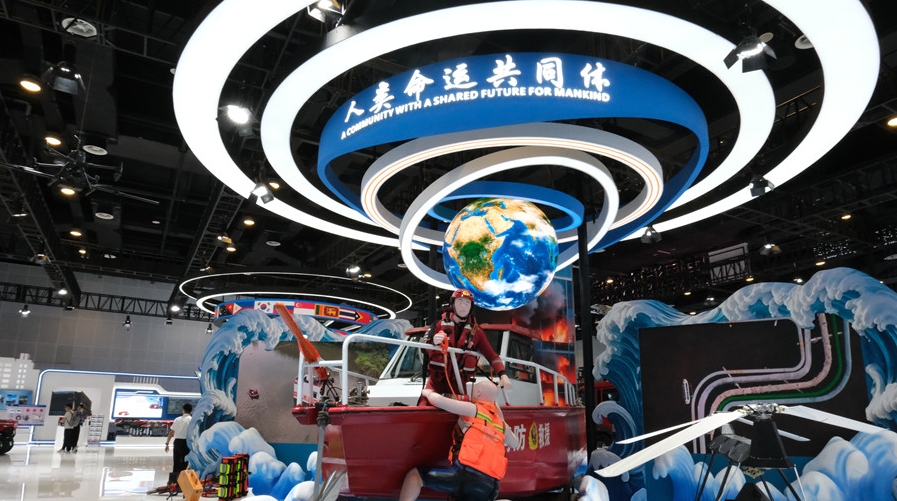
At the China Fire and Rescue Exhibition, an 825-square-meter space recreates water rescue and urban fire scenarios, with a suspended globe at its center projecting a real-time map of global disaster hotspots. The exhibition focuses on AI-enabled emergency response.
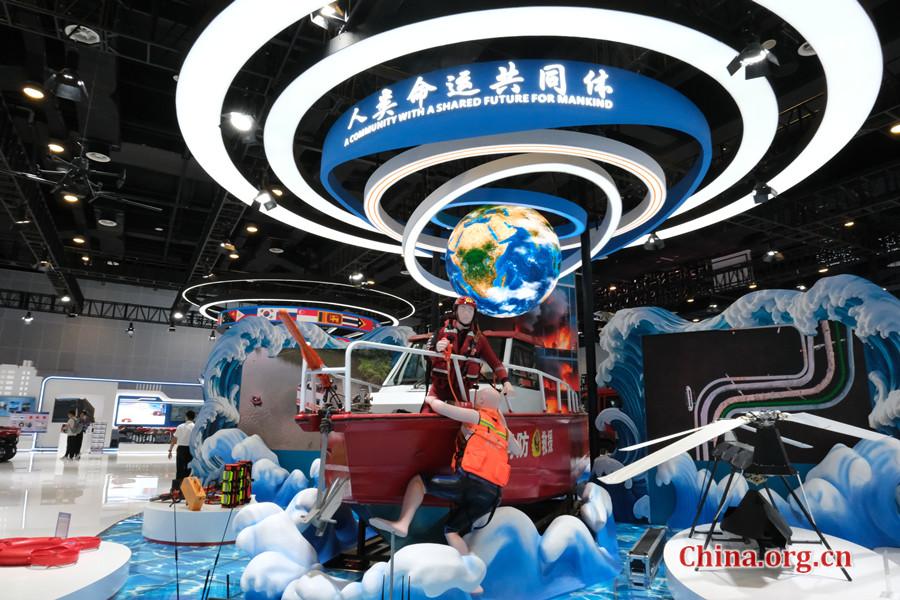
The China Fire and Rescue Exhibition at the 23rd China-ASEAN Expo in Nanning, Guangxi Zhuang Autonomous Region, Sept. 17, 2026. [Photo by Liao Jiaxin/China.org.cn]
In the water rescue zone, an AI underwater robot is designed to dive to 350 meters and hold its position using visual algorithms, work that would otherwise require a diver. Beside it are a flying lifebuoy built to cross rapids at 12 meters per second and the DB-400 helicopter, the first Chinese model tested in the Arctic.
The display is part of the third urban emergency rescue exchange under the ASEAN Regional Forum, where Chinese and ASEAN teams are discussing how AI can speed up cross-border disaster response.
In the new energy and intelligent connected vehicle exhibition area, Guangxi Automobile Group showed a range of driverless delivery vehicles, from small 0.1-cubic-meter models to 6-cubic-meter ones, with larger versions in development. The 6-cubic-meter Y06 carries 1.6 tons and runs 300 kilometers on a single charge. It is designed for parks, supermarkets and residential communities.
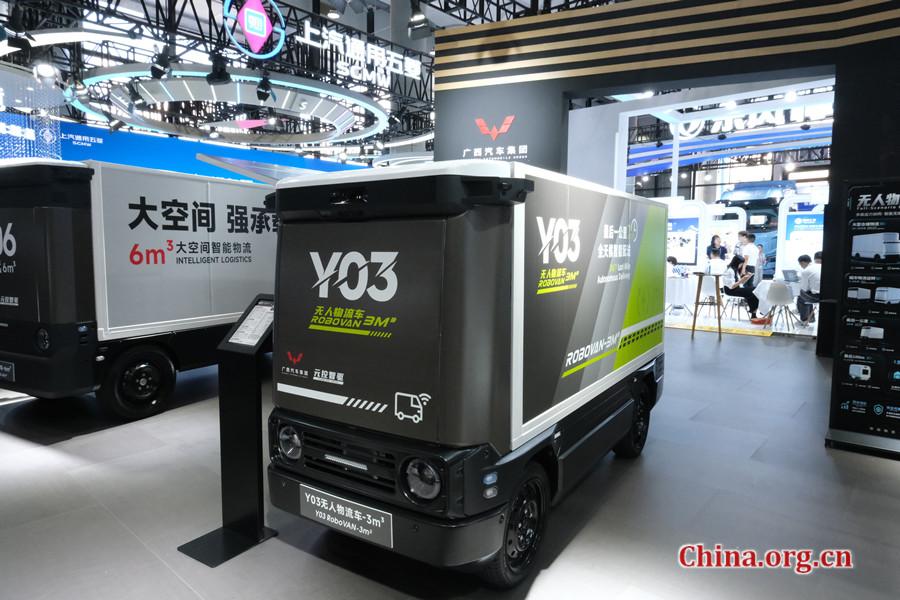
Driverless delivery vehicles displayed by Guangxi Automobile Group at the 23rd China-ASEAN Expo in Nanning, Guangxi Zhuang Autonomous Region, Sept. 17, 2026. [Photo by Liao Jiaxin/China.org.cn]
"The vehicle uses advanced lidar and vision systems to drive fully on its own," said Liao Lingyi, who oversees marketing and investment at the group. "We have deployed more than 1,000 units in China, and it has reached mass production."
Liao said the company is working on product adaptation and regulatory compliance for Southeast Asian markets, making sure the batteries meet local rules and the autonomous driving system can handle local road conditions.
If Guangxi Automobile Group builds vehicles for different cargo sizes, Go Further.AI, a Chinese autonomous driving company, takes the opposite approach, letting the cargo define the vehicle. Its ABA platform, making its debut at the expo, does away with a traditional chassis: the floor lowers to the ground, letting a cage roll straight into the cargo bay without a forklift.
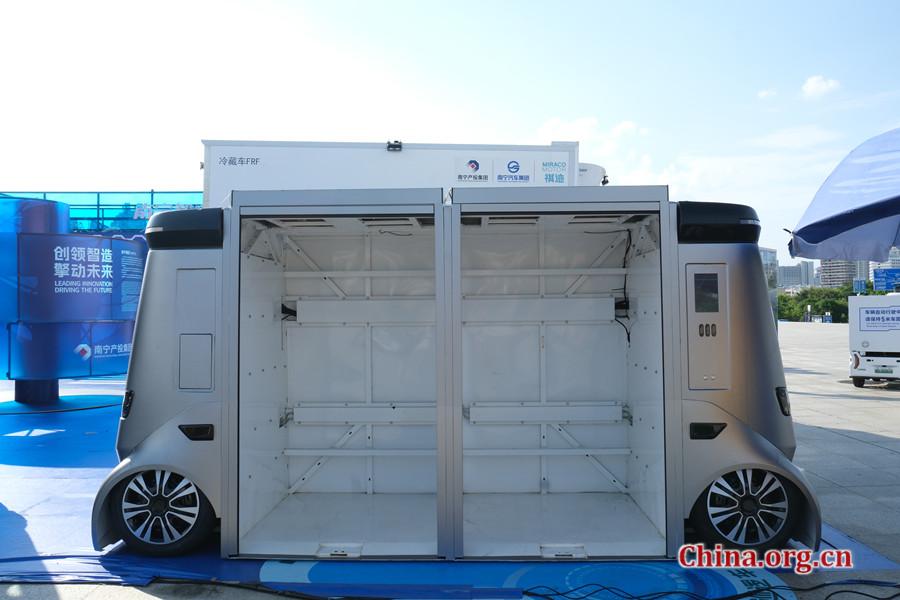
The ABA platform displayed by Go Further.AI at the 23rd China-ASEAN Expo in Nanning, Guangxi Zhuang Autonomous Region, Sept. 17, 2026. [Photo by Liao Jiaxin/China.org.cn]
"Our inspiration comes from shipping containers," said Yang Fang, the company's senior marketing director. The company applies that logic to the smaller containers used in city delivery, leaving the definition of the cargo box to the customer. Yang summed up the approach as "AI plus logistics": the vehicle drives, routes and delivers on its own, and the customer only decides what goes inside.
On the consumer side, the expo debuted an "AI Mega Market" as part of a broader push to bring Chinese AI products to ASEAN buyers. The market features more than 500 products from more than 70 companies, with a dedicated ASEAN cross-border livestream zone demonstrating multilingual digital human sales.
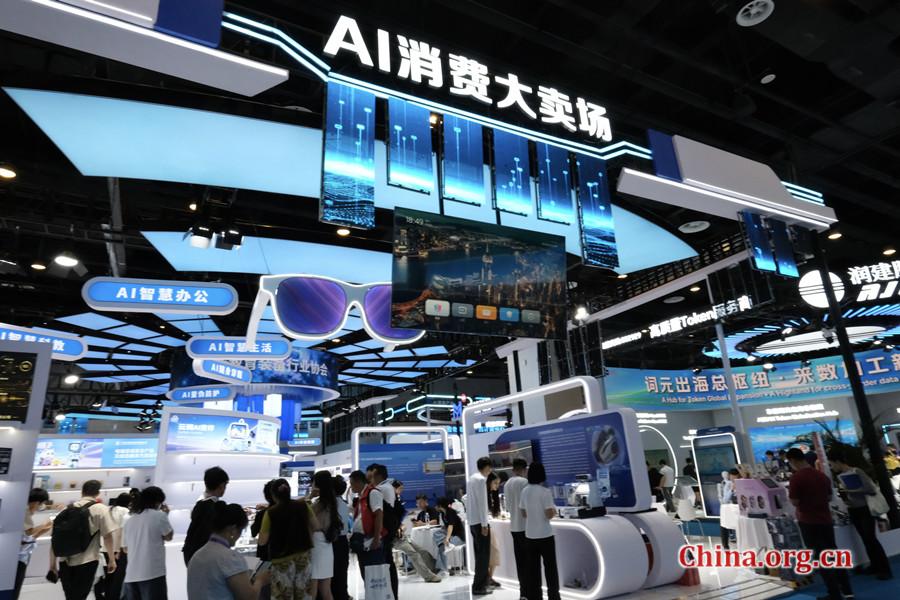
Visitors explore the "AI Mega Market" at the 23rd China-ASEAN Expo in Nanning, Guangxi Zhuang Autonomous Region, Sept. 17, 2026. [Photo by Liao Jiaxin/China.org.cn]
From underwater rescue to city delivery to consumer gadgets, Chinese AI companies at this year's expo showed how their technology is moving from specialized missions into everyday life, and from China into Southeast Asia.


 京公网安备 11010802027341号