RSSNewsletterSiteMapFeedback

Home · Weather · Forum · Learning Chinese · Jobs · Shopping
Search This Site
China | International | Business | Government | Environment | Olympics/Sports | Travel/Living in China | Culture/Entertainment | Books & Magazines | Health
Home / Environment / News Tools: Save | Print | E-mail | Most Read | Comment
Animals starving because of a lack of funds
Adjust font size:

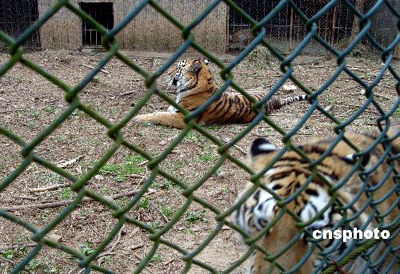
Animals at Three Gorges Forest Wild Animal World, which has been in the spotlight since one of its Siberian tigers was found beheaded and skinned, are on the verge of starvation because of a lack of funds.

Siberian tigers at the Three Gorges Forest Wild Animal World

Zookeeper Wang Jianxiang said the zoo had been struggling to provide enough food and medical care for the animals.

"We can't afford to buy pork for the animals, so instead we feed them chicken bones, beef liver and vegetables."

The zoo, a mostly private venture located in the suburbs of Yichang City, opened in October 2002. During its first few months in business, it attracted hordes of visitors, Qin Maolin, a retiree who used to work at the zoo, said.

He said all the animals came from a bear and tiger breeding company based in Guilin, Guangxi Zhuang Autonomous Region.

However, many animals died of hunger in 2003 during the SARS outbreak. Visitor numbers never recovered.

Last Thursday morning, a female Siberian tiger that was between six and seven years old was found dead at the zoo with its head, legs and skin missing. Over the weekend, the remains of two baby tigers were found in a refrigerator in the facility's ticket office.

Cao Guangyi, an official with the Yichang forestry bureau, said the two Bengal cubs had died at birth on November 28. Workers put the carcasses into the refrigerator to preserve them.

According to the national law on wildlife protection, zoos must get the approval of local authorities before disposing of deceased wild animals. However, the zookeepers did not report the deaths until the bureau started to investigate the matter on Saturday.

Cao said the zoo should have reported the deaths to the forestry bureau and then disposed of the bodies in accordance with the bureau's findings.

"The bureau has ordered the zoo to shape up its management and make sure employees understand the laws and regulations on wildlife protection."

Siberian tigers, among the world's 10 most endangered species, mostly live in Northeast China and the Russian Far East. Of the 400 estimated to be living in the wild, only 10 to 17 live in China.

By law, people who kill endangered or rare wild animals face a maximum of 10 years in prison.

Forestry police are investigating the tiger's death.

Covering about 40 hectares, the zoo, located 14 km from Yichang city, is home to more than 100 species of wild animals, including 15 tigers, five bears, six African lions, two wolves, 60 monkeys and some birds.

The facility has only five employees to oversee breeding, management and ticket sales.

"The zoo is losing money," Wang said. "This month, we have had only 20 visitors."

(Xinhua News Agency December 26, 2007)

Tools: Save | Print | E-mail | Most Read

Comment
Username   Password   Anonymous
 
China Archives
Related >>
- 7 other tigers dead in central China zoo
- Laws and regulations on the protection giant pandas
- Two tiger cubs found dead in zoo refrigerator
- Animals trained to behave during health check-up
- Tiger eats tiger in Liaoning zoo
Most Viewed >>
-Severe winter weather may persist for another week
-Battle goes on against snowstorms
-Salt tide afflicts Shanghai
-La Nina, atmospheric circulation blamed for snow disaster
-New snow set to cause further havoc on roads
Air Quality 
Cities Major Pollutant Air Quality Level
Beijing sulfur dioxide II
Shanghai particulate matter I
Guangzhou sulfur dioxide I
Chongqing particulate matter II
Xi'an particulate matter II
Most Read
-Severe winter weather may persist for another week
-Battle goes on against snowstorms
-Salt tide afflicts Shanghai
-La Nina, atmospheric circulation blamed for snow disaster
-New snow set to cause further havoc on roads
NGO Events Calendar Tips
- Hand in hand to protect endangered animals and plants
- Changchun, Mini-marathon Aimed at Protecting Siberian Tiger
- Water Walk by Nature University
- Green Earth Documentary Salon
- Prof. Maria E. Fernandez to Give a Lecture on Climate Change
More
Archives
UN meets on climate change
The UN Climate Change Conference brought together representatives of over 180 countries and observers from various organizations.
Panda Facts
A record 28 panda cubs born via artificial insemination have survived in 2006.
South China Karst
Rich and unique karst landforms located in south China display exceptional natural beauty.
Saving the Tibetan Antelopes
The rare animals survive in the harsh natural environment of the Qinghai-Tibet Plateau.
More
Laws & Regulations
- Forestry Law of the People's Republic of China
- Meteorology Law of the People's Republic of China
- Fire Control Law of the People's Republic of China
- Law on Protecting Against and Mitigating Earthquake Disasters
- Law of the People's Republic of China on Conserving Energy
More
Links:
State Environmental Protection Administration
Ministry of Water Resources
Ministry of Land and Resources
China Environmental Industry Network
Chengdu Giant Panda Research Base
SiteMap | About Us | RSS | Newsletter | Feedback

Copyright © China.org.cn. All Rights Reserved E-mail: webmaster@china.org.cn Tel: 86-10-88828000 京ICP证 040089号