As an important component of international exchanges and
cooperation, international students education has been given great
importance by the Chinese government. Due to half-century's
painstaking efforts, an international students administration
system, with distinct Chinese characteristics, has been
constructed. This system has helped to produce a number of talents
in the fields of science, technology, education, diplomacy,
management, etc. for many countries, especially developing
countries, and played an active role in enhancing the political,
diplomatic and economic ties between China and those countries as
well as promoting the exchange of culture, education and
personnel.
In 1950, China received the first group of 33 students from the
East European countries. By the end of 2000, the total number of
international students in China has increased to 407,000. They are
from more than 160 different countries. Among them, Chinese
Government Scholarship students numbered 88,000, whereas
self-financed students reached 317,000. Since 1997, the Chinese
Scholarships Council (CSC) has been entrusted by the Ministry of
Education with the enrollment and administration of daily
operations concerning international students in China sponsored by
Chinese Government Scholarships.
Since 1978 when China initiated her reform and opening-up
policy, international students education has entered into a new
stage. From 1979 to 1999, the total number of international
students studying in China reached 342,000 person-times. China has
been successful in maintaining social and political stability and
the rapid growth of economy, and this in return gives rise to the
international students. In 1996, the total of international
students reached 41,000, an increase by 30% over 1992. Furthermore,
the enrollment of self-financed students made such a big stride
that it has surpassed that of scholarship students, and became the
main stream of the international students.
The outbreak of SARS in 2003 had brought great difficulties. In
order to implement the 2003-2007 Action Plan for Rejuvenating
Education, the Ministry of Education had worked creatively on the
policy of "expand the size, raise the level, guarantee the quality
and regulate the management". The difficulties that SARS had caused
were surmounted and the number of the students was basically
stabilized. Totally 77,715 students of different types from 175
countries were accepted by 353 Chinese higher education
institutions.
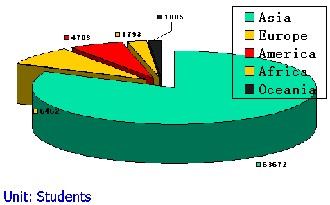
International students from Asia still top the list of all,
totaled 63,672, accounting for 81.93% (see Graphic 1). While 6,462
students are from Europe, accounting for 8.31%; 4,703 from America,
accounting for 6.05%; 1,793 from Africa, accounting for 2.31%, and
1085 from Oceania, accounting for 1.04%.
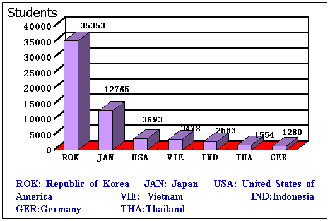
South Korea, Japan, the United States, Vietnam and Indonesia are
the top five countries that have the largest numbers of
international students in China, numbered 35,353, 12,765, 3,693,
3,478, and 2,563 respectively. Other countries, which have over
1,000 students in China, are Thailand (1,554), Germany (1,280),
Russia (1,224), Nepal (1,199) and Mongolia (1,060).
 |
According to the agreements or programs signed by Chinese
government and the governments of other countries as well as
international organizations, China's Ministry of Education offered
to 163 countries Chinese Government Scholarships in 2003.With the
1,879 new numbers, actually 6,153 foreign students were admitted,
making up 7% of total number, of which Asia students amounted to
3,076, covered 50% of the total, European students 1,442, 23%,
Africa 1,244, 20%, America 305, 5%, Oceania 86, 1.4%. With the
principle of raising the level of scholarship students, Ph.D
students increased to 609, Master Degree students added up to
1,350, and undergraduate students 1,754. In addition, 123 students
were benefited from the other scholarship provided by Chinese
Government, including the Great Wall Scholarship, the Excellent
Student Scholarship, the HSK Winner Scholarship, the short-term
program for foreign teachers of Chinese and the Chinese culture
research program. As for the self-financed students, the enrolment
has expanded to 71,562, among them, short-term students (who
studied for less than 6 months) numbered 13,202, whereas long-term
students who studied in China for over 6 months (including 6
months) numbered 58,360.
In accordance with the relevant regulations on the management of
Chinese Government Scholarship formulated by the Ministry of
Education, to reinforce the management of Chinese Government
Scholarship and to bring its benefits and effects into full play,
the Ministry of Education of China entrusts China Scholarship
Council (CSC) to take charge of the organization and implementation
of Annual Review of the Chinese Government Scholarship students.
And the institutions are entitled to give Annual Review to their
own scholarship students.
To convenience international students, along with some
consulting booklets, the China Scholarship Council (CSC) and
Chinese Service Center for Scholarly Exchange (CSCSE), directly
under the Ministry of Education, also provide on-line enrollment
and information consulting.
On February 16, 1998, the Conference on Study by Foreign
Students in China was convened, which, coming up with the policy of
"deepening reform, improving management and guaranteeing
educational quality to achieve vigorous and steady development",
the former State Education Commission, analyzed the new
circumstances faced by the international students education and
consequently laid down tasks to be fulfilled in recent years. This
is a milestone in Chinese international students education.
(Ministry of Education of the People’s Republic of China October
20, 2006)