UNAIDS: New HIV infections down 17% worldwide
 0 Comments


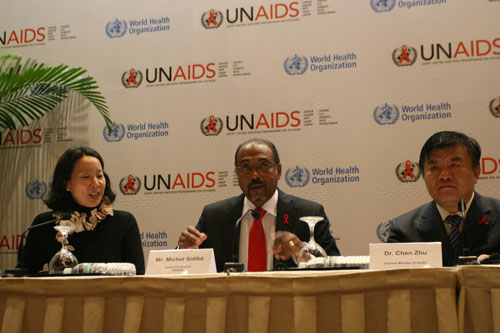
According to 2009 figures, new HIV infections have been reduced by 17 percent over the past 8 years, said the executive director of UNAIDS Michel Sidibé at a press conference held in Shanghai on November 24, 2009.
 |
|
Executive Director of UNAIDS Michel Sidibé (middle) and Health Minister of China Chen Zhu meet with the press in Shanghai, November 24, 2009. [Wang Zhiyong/China.org.cn] |
The number of new infections in sub-Saharan Africa is approximately 15 percent lower than what it was in 2001, when the UN signed the Declaration of Commitment on HIV/AIDS. That means there were about 400,000 fewer infections in 2008.
In East Asia, new HIV infections declined by nearly 25 percent; in South and Southeast Asia, there was a 10 percent decline.
The report highlights that HIV prevention programs are making a difference.
"The good news is that we have evidence that the declines we are seeing are due, at least in part, to HIV prevention," said Sidibé.
 |
|
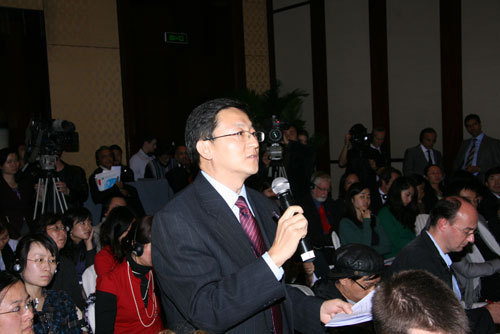
China.org.cn Deputy Director Wang Xiaohui raises a question at the press conference. [Wang Zhiyong/China.org.cn] |
The report found that 33.4 million people are living with HIV worldwide, 2.7 million people were newly infected in 2008, and 2 million people died of AIDS-related illnesses in 2008.
China confirms 319,877 people living with HIV-AIDS
As of the end of October, the number of Chinese citizens confirmed to be living with HIV-AIDS was 319,877—that is an increase from the 264,302 last year and more than double the 135,630 that were reported in 2005, China's health minister Chen Zhu said at the press conference.
 |
|
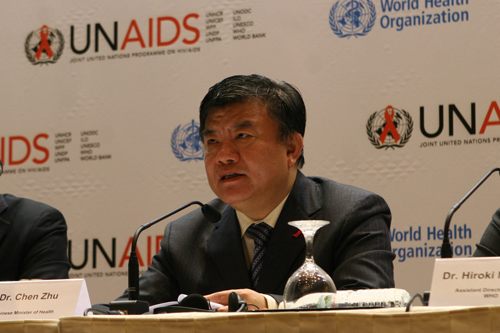
Health Minister of China Chen Zhu takes questions during the press conference.[China.org.cn] |
According to estimates by UNAIDS and the Ministry of Health, China is expected to have about 740,000 people infected with the HIV virus by the end of this year.
"The exact number of infections keeps rising in the nation but at a lower speed compared with previous years," said Chen.
He noted that the government has been providing free voluntary blood tests, free anti-retroviral treatments for AIDS patients with economic difficulties, free medical advice and treatment for pregnant women and infants, free education for AIDS orphans and governmental care for AIDS patients who live in poverty.
When answering a question from China.org.cn Deputy Director Wang Xiaohui, Sidibé highly praised China's efforts on AIDS prevention and care in recent years. China has seen a decrease in infant infections due to mothers living with HIV, and has increased its medicare coverage of AIDS patients.
Chen said that the central government's funding for AIDS control topped one billion yuan in 2009, while special funds appropriated from the central government to local governments amounted to 989 million yuan.
"In China, we have a long way to go to prevent and control HIV-AIDS. China appreciates and welcomes the support of the international community," Chen said. "China wishes to conquer AIDS with the world by expanding international cooperation and learning from the experiences of other countries."
So far, China has 276 AIDS control programs that are jointly operated with more than 40 foreign governments or international organizations. Running these programs involves 3.58 billion yuan in funds.
 |
|
China.org.cn reporting live at the press conference.[China.org.cn] |
Sex contact main cause for HIV's spread in China
The report revealed that HIV, the virus that causes AIDS, is now spreading in China mainly through sex. This trend will demand new strategies to stave off a rebound in the epidemic after years of progress in containing it.
Data show that 40 percent of new HIV infections diagnosed in China were acquired through heterosexual contact, with homosexual sex accounting for 32 percent.


Comments