Britain seeks global partnership with China post-Brexit
- By Christopher Georgiou
 0 Comment(s)
 Print
Print E-mail China.org.cn, April 11, 2018


David Lidington, the chancellor of the Duchy of Lancaster and minister for Britain's Cabinet Office, is on a three-day visit to China this week, building on the announcement of a new chapter in the "Golden Era" between the U.K. and China.
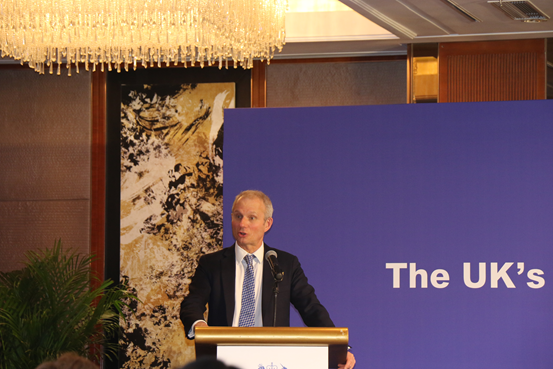
He is leading the 10th U.K.-China Senior Leadership Forum, a unique partnership that brings together British parliamentarians and senior members of the Communist Party of China for frank discussions, debates and collaboration, according to the U.K. Cabinet Office.
At the Kerry Hotel in Beijing on Tuesday, Lidington addressed alumni of Chevening, the U.K.'s international awards program dedicated to "developing global leaders," as well as members of the Chinese government in a speech outlining the challenges and opportunities of Brexit.
"As the U.K. leaves the EU we will no longer be members of its single market or customs union, but what we are seeking is the broadest and deepest possible agreement which covers more sectors and cooperates more deeply than any other free trade agreement … while respecting each other's institutions and autonomy," he said.
"The U.K. and the EU recently reached an agreement of the terms of a time-limited implementation period from next year. The U.K. will no longer be a member state of the EU, but market access will continue on current terms, and common rules will remain in place until the end of the implementation period until the end of 2020."
He said that China will remain an increasingly important partner for the U.K. During the implementation period, the U.K. will be free to negotiate, ratify and sign trade deals with new partners, while continuing to benefit from the EU's existing arrangements.
"There are huge trading opportunities in China which we want to help businesses from all four parts of the U.K. to take advantage of. Total trade, in goods and services, between the U.K. and China in 2017 was 68 billion British pounds – a 13.8 percent increase from 2016," Lidington said, adding that, "We look forward to continuing to work with the Chinese government to make progress on market access and remove barriers to trade in order to realize our joint ambition of an open global economy that works for all."
Lidington also paid tribute to the strong cultural ties, including educational exchanges and other joint exchange mechanisms such as Chevening and the leadership development program Global Partners 2020, that will underpin the bilateral relationship.
Wang Houxin, senior technology manager at CITIC Metal Co. and a current applicant to the Chevening program, told China.org.cn after the event that he was not overly concerned over Brexit. "Although there may be small losses for the U.K., overall the gains will be greater," he said, adding that, "There will be more opportunities for U.K.-China relations, as the U.K. can be more flexible in its trade and investment relationships."
When asked if the U.K. would still be an attractive destination for Chinese investment after leaving the EU, Ji Bin, vice president of the All-China Federation of Taiwan Compatriots and member of the National Committee of the Chinese People's Political Consultative Conference, told China.org.cn that it will depend on what kind of final deal can be reached.
"The U.K. is still attractive for China, as it has its own strengths including not only the soft power of education and culture but also advanced technologies and innovation to offer China," said Ji, who is also a senior Chevening alumnus. "Although Germany is China's largest trading partner in the EU, the U.K. is the largest investment destination, and I think that will continue a strong development trend."
The theme of the 10th leadership forum this year is "Partners for Progress: Strengthening the U.K.-China Relationship in the Golden Era," and will focus on practical cooperation between the U.K. and China in light of Brexit.
Minister Lidington is scheduled to meet a number of officials from the Chinese government, including the newly appointed vice president, Wang Qishan. He will be the first British politician to meet Vice President Wang, who previously served as Chinese President Xi Jinping's anti-corruption head.


Go to Forum >>0 Comment(s)