Extra classes constrict Chinese children
- By Pang Li
 0 Comment(s)
 Print
Print E-mail China.org.cn, October 17, 2012


 |
|
File photo [Chuangwei] |
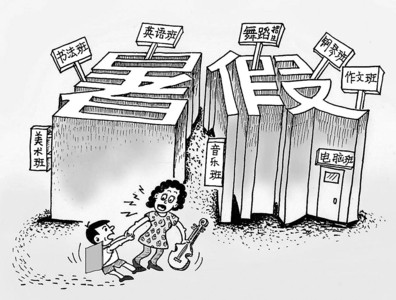
With the aim of getting their offspring accepted into prestigious colleges, Chinese parents now are cramming classes into their young children's everyday life. This excessive education leaves the youngsters little time to play with their peers or do what they like and, on a far more serious note, can prove harmful to their character development, raising concerns among education experts.
Facing limited education resources, Chinese parents are inclined to start worrying about their children's future when the children are still very young. Convinced that their little ones mustn't be left behind from the start, they make sure the children get what they consider to be the best education available, starting from kindergarten.
Not only do the little boys and girls take classes at kindergartens or schools, but they also receive tutoring after school hours either to strengthen their academic performances or learn extra curriculum. In addition, their parents enroll them in so-called hobby classes during the weekends and holidays to learn piano, painting, dancing and even very complicated mathematics, since an artistic skill or trophy can add extra points to the scores of the examinations for advancing onto a higher level of education, according to some regulations.
Now many cities are witnessing the rather bizarre scene of parents setting up small tents outside training institutions on weekends for their children who can then take a nap during a midday break from a daylong hobby courses. Even four- or five- year-olds are not spared from these weekly hobby classes.
However, classes of this kind cause aversion instead of love for what they learn. One piano teacher said: "Many children who reached the piano level 10 have vowed to never touch a piano again. They don't think music is their lifelong company because it robs them of playing time."
The excessively early education can also create more serious problems. Wang Fang, a pre-school education expert, explained that a young child who is forced to take various costly hobby classes before reaching school age, can show psychological problems when the child enters primary school.
Wang Fang described the parents' arrangements for their children as "hasty, insane and terrible," and said "I think children now are living a very miserable life." Pre-school age is for playing games and running around. To make little children start learning arithmetic and Chinese characters at a pre-school age could result in curbing their imagination, Wang said.
Lu Linyue, vice-president of the Zhejiang Society of Education said that nowadays parents are suffering from collective anxiety disorder, a reflection of the social anxiety in an economic growth obsessive society. They carry in them a much stronger desire than previous generations for helping their only child to succeed in the future.
Feng Gang, a professor at Zhejiang University said that China has seen the path for social advancement narrowing as the social structure has been getting more rigid from the 1990s onwards. Now it seems that a good higher education is the only way for common people to climb the social ladder. That is why parents give everything they have to get their children prepared , Feng said.
Lu Linyue called on adults to change their perception on parenting. They should treat their children as independent individuals and create a nice environment for their overall growth.
Chen Fei, headmaster of Qinghe Middle School, Hangzhou, Zhejiang Province, said that since children are individuals with independent thoughts and personalities, neither teachers nor parents have the right to design their future for them.
Meanwhile, Chinese authorities have realized the harms of excessive education. Now, primary and middle schools are prohibited from providing classes to the students. On October 9, 2012, the Ministry of Education issued education guidelines for children aged three to six and banned any teachings beyond the appropriate level in kindergartens or the first grade.


Go to Forum >>0 Comment(s)