Communication experts eye information trend
- By Wu Jin
 0 Comment(s)
 Print
Print E-mail China.org.cn, October 24, 2012


Obituaries on W.E.B. Dubois, a Pan-African and pro-communist activist, published by both the New York Times and People’s Daily in 1963, explore a history when the world was divided between two ideological poles.
Taking note of the Times’ specific but aloof description of the Daily's passionate writing, Vera Fennel, an associate professor at Lehigh University in the U.S., brought an interesting historic case to light at the International Conference on Communication and Global Power, recently held at Communication University of China in Beijing.
 |
|
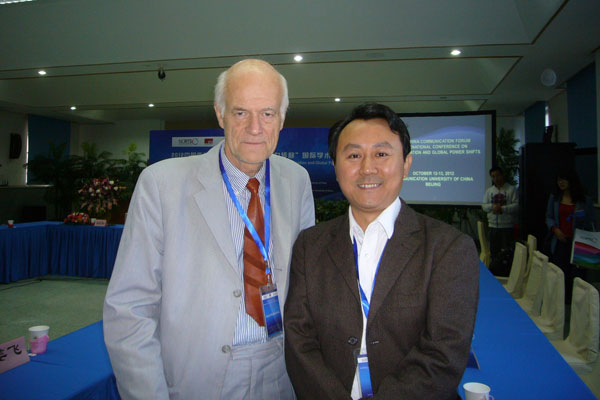
Prof. Kaarle Nordenstreng (L) and Prof. Jiang at the the International Conference on Communication and Global Power, recently held at Communication University of China in Beijing. [courtesy of Chinese Academy of Social Sciences] |
Concluding her speech as "A tale of two audiences", Fennel explained that obituaries are often historically important, as is the case of Dubois, and exemplify two different discourses incorporating special ideological values and meanings.
Kaarle Nordenstreng, professor emeritus at the School of Communication, Media and Theater of the University of Tampere, Finland, had a lot to say regarding information flow over the past few decades, and spoke of his experiences as a first-hand witness to its continued evolution.
Nordenstreng told the conference about his 45-year-long academic life exploring the world. Drawing on an emerging geo-political demand to educate international audiences on the western world's fierce contradictory measures, as well as subsequent compromises leading to the publication of the “Macbride Report” and "Many Voices, One World" during the 1980s, Nordenstreng believes struggles in information management are far from over.
The ensuing formation of media conglomerates and rampant globalization all substantiate the New World Information and Communication Order (NWICO) coined by the developing world at UNESCO during the late 1970s, and await continued confrontation through thoughts and ideas.
When concluding his representation, Nordenstreng said that NWICO was not really about media and communication, but focuses instead on "high politics".
 |
|
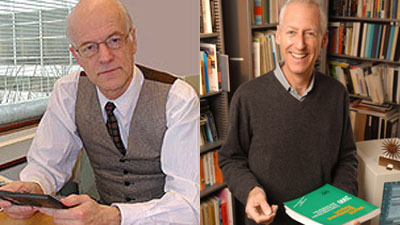
prof. Kaarle Nordenstreng (L) and prof. Dan Schiller (R) [file photo] |
"The determining factors boosting the concept into such a high status were socioeconomic and geographic forces, rather than intellectual and moral arguments. In other words, power rather than reason set the rules of the debate," he wrote in his presentation handout.
The debate over the information world order has waxed and waned over the years, but has never ceased. Last year, the Wall Street Journal used a whole column to publish an opinion piece written by Li Congjun, president of China’s state-owned Xinhua News Agency. In his article, Li criticized international media and said it lags behind the times. He proposed establishing a "media UN" to grant fair and inclusive industry development.
However, his idealistic mindset will have to compete with strong capital flows that permeate the global landscape and exert a substantial level of influence in forming and disseminating information.
Dan Schiller, a historian and professor of communications at the University of Illinois, U.S.A, placed a positive spin on capital accumulation despite the growing negative trend of unilateral globalization pursued by the Obama administration.
According to Mr. Schiller, modern information flows shape according to capital investments, and are emphasized not by quantity but by quality. He believes under enhanced economic strength, the working classes, including those in China, are less constrained against a general social environment.
"The working classes are no longer the people working only for wages, they are thinking and [burning] with a kind of feeling to improve the world," Schiller said during the conference.
|
|
|
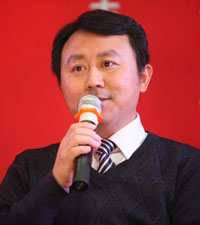
prof. Jiang Fei [Sina.com.cn] |
"Having spent 500 years using the media as a daily information tool, the working class is forming a tendency to focus on the basic facts of their own world and discussing current issues," he said.
And he believes this tendency is expanding from Mexico to Egypt, from Japan to China and penetrating into a variety of disciplines including education, biological research, cultural heritage protection and intercultural communication.
"That's the modification during the change when the working class struggling to realize their own ideas," Schiller said.
Jiang Fei, a cross-cultural communication professor with the Chinese Academy of Social Sciences said, "this section of the [conference] is important not only because of big names, [like, Nordenstreng and Dan,] but also because of the power-shifting issues that it concerned."
"Such discourse should be deemed as a restarting point for the relay of the NWICO, not only for China but also the world as a whole," he added.


Go to Forum >>0 Comment(s)