China responds positively to Trump's greetings
 0 Comment(s)
 Print
Print E-mail Xinhua, February 10, 2017


China on Thursday confirmed that it has received a letter to President Xi Jinping, sent by U.S. President Donald Trump, who extended his greetings ahead of the Lantern Festival.
|
|
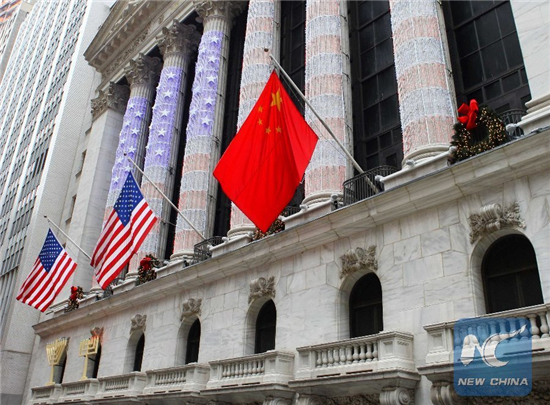
| The national flags of the United States and China wave out of the New York Stock Exchange (NYSE) in New York, the United States, Jan. 5, 2009. [Photo/Xinhua] |
Foreign Ministry spokesperson Lu Kang made the remarks at a daily press briefing, responding to reports that Trump on Feb. 8 sent a letter to President Xi, wishing Xi and the Chinese people a happy Lantern Festival and saying that he looked forward to working with China to develop a constructive relationship that "benefits both countries."
"China attaches great importance to developing the relationship with the United States," said Lu.
China is ready to work with the U.S. side to expand cooperation and manage any differences guided by the principles of upholding non-conflict and non-confrontation, mutual respect and win-win cooperation, so that bilateral ties develop in a healthy and stable way, said Lu.
Lu added, just as President Xi has said, China and the United States both had a responsibility to safeguard world peace and stability, and promote global development and prosperity.
"Cooperation is the only right choice for China and the United States,"said Lu.
Lantern Festival, which falls on Feb. 11 this year, is held to mark the first full moon of the new lunar year. It falls on the 15th day of the first lunar month. Chinese people consider it to be one of the country's most important holidays.
His letter may help to end speculation that Trump made an intentional slight by being the only US president in recent years not to have sent greetings at the Chinese Lunar New Year.
![US President Donald Trump has sent a message to Chinese President Xi Jinping, wishing the Chinese people a happy Lantern Festival, which marks the last day of the Chinese New Year holiday, as well as a prosperous Year of the Rooster. [Photo/Xinhua]](http://images.china.cn/attachement/jpg/site1007/20170209/b8aeed990a581a065cd908.jpg "US President Donald Trump has sent a message to Chinese President Xi Jinping, wishing the Chinese people a happy Lantern Festival, which marks the last day of the Chinese New Year holiday, as well as a prosperous Year of the Rooster. [Photo/Xinhua]") |
|
US President Donald Trump has sent a message to Chinese President Xi Jinping, wishing the Chinese people a happy Lantern Festival, which marks the last day of the Chinese New Year holiday, as well as a prosperous Year of the Rooster. [Photo/Xinhua] |
Donald Trump's letter conveys the reassuring message that bilateral relations are still on the right track despite the speculation that has arisen with Trump's victory in the November election, and his breaking of long-held norms and practice that used to guide bilateral ties - on Taiwan, the South China Sea and trade.
Fueling the tensions has been the belligerent attitude of some of the members of the Trump administration, which has increased concerns that a military confrontation is in the cards. US Secretary of State Rex Tillerson, for instance, has suggested China's access to its islands in the South China Sea might be blocked, while Steve Bannon, the chief strategist in Trump's team, said he believed that the US would go to war with China within five to 10 years during a radio broadcast last year.
Against this backdrop, the letter, though terse and issued nearly three weeks after Trump's inauguration, is still a positive signal, as it suggests that reason still prevails in the White House. Although it is still too early to conclude Trump no longer seeks to antagonize China, this show of goodwill will to some extent minimize the possibility of antagonistic rhetoric being turned into policies or actions that will set the two giants on a collision course.
China consistently holds that cooperation, rather than confrontation, is the only choice for the two countries, and that both should try to manage and control the disputes and sensitive problems that exist between them.
The fact that their shared interests far outweigh their differences determines that if there is a clash between them, "both will lose and both cannot afford that", as Foreign Minister Wang Yi said earlier this week during a visit to Australia.
The US seems to echo this sentiment. US Defense Secretary James Mattis, during a visit to Japan last week, emphasized the importance of giving diplomacy priority in solving the disputes in the South China Sea, raising hopes that the sea will not necessarily become a flashpoint for conflict.
Trump's letter to President Xi Jinping is a goodwill gesture that will ease efforts to find more common ground between the two countries and lower the risk of clashes in the Western Pacific, analysts said.
After assuming office, Trump said China and Japan were currency manipulators. Beijing and Washington have traded barbs recently over sensitive topics, such as the Diaoyu Islands issue.
The US secretaries of state and defense assured Japan in recent days that the Diaoyu Islands fall within the scope of a US-Japan military treaty.
Su Xiaohui, a researcher of international strategy at the China Institute of International Studies, said Trump wrote the letter to "display more goodwill to Beijing and to convince people that he cares more about how China feels".
"The letter could be taken as a signal that Trump is shifting his role from a business tycoon to a state leader who takes a comprehensive view of international relations and tackles them in a win-win manner," Su said.
Xi had sent a congratulatory telegram to Trump on his election victory last year.
Earlier this month, Trump's daughter Ivanka visited the Chinese embassy in Washington for the first time with her 5-year-old daughter, Arabella Rose Kushner, to participate in the embassy's Chinese Spring Festival celebration.
On Wednesday, Bloomberg quoted an unnamed White House official who said Ivanka Trump's public meeting came after behind-the-scenes meetings between Ambassador Cui Tiankai and Jared Kushner, her husband and a presidential adviser.
Kushner and Cui have had an extensive, ongoing dialogue that has been positive, the report said.
Yuan Zheng, a senior researcher on US foreign policy at the Chinese Academy of Social Sciences, noted that Trump has recently drawn fire because of domestic issues such as immigration and has aroused hostility overseas.
Writing to Xi and pledging constructive ties with Beijing shows that stabilizing US-China ties is "of greater significance" for Trump, Yuan said.
Ruan Zongze, vice-president of the China Institute of International Studies, said that "what China hopes to see is the soft landing of the two-way ties, and even further development at the new starting point".


Go to Forum >>0 Comment(s)